
This article originally appeared in Mongabay.
North Atlantic long-finned pilot whales (Globicephala melas) now have 60% lower concentrations of some legacy PFAS than they did a decade ago, offering rare good news about the effectiveness of chemical regulations, Harvard University researchers report in a new study.
The study, published in the Proceedings of the National Academy of Sciences, analyzed tissue samples from pilot whales collected in the Faroe Islands between 1986 and 2023. Researchers measured bulk organofluorine, a proxy for total PFAS contamination, as well as individual compounds in liver and muscle tissues.
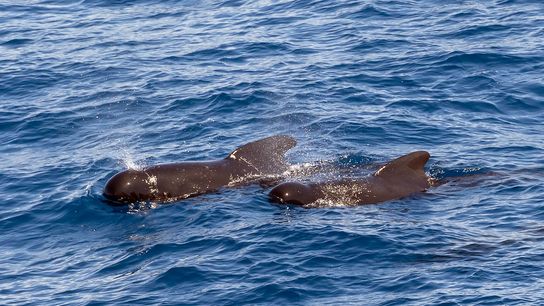
Charlie Jackson via Flikr (CC BY 2.0.)
North Atlantic long-finned pilot whales (Globicephala melas) now have 60% lower concentrations of some legacy PFAS than they did a decade ago.
PFAS (per- and polyfluoroalkyl substances) are synthetic chemicals used since the 1950s in products ranging from non-stick cookware and waterproof clothing to food packaging and firefighting foam. Legacy PFAS are older compounds that were used for decades but are generally no longer produced for industrial use. Their extreme stability has earned them the nickname “forever chemicals,” as they persist in the environment and accumulate in the tissues of living organisms.
PFAS exposure has been linked to numerous health problems in humans and wildlife, including liver damage, immune system suppression, developmental problems, thyroid disease, and certain cancers. The chemicals bioaccumulate in the food chain, meaning concentrations increase at each level, with top predators like whales and humans facing the highest exposures.
The new research revealed that organofluorine concentrations in pilot whale livers peaked around 2011 and declined by more than 60% by 2023. This represents roughly a decade-long lag after major manufacturers began phasing out production of the most problematic legacy PFAS in the early 2000s due to toxicity concerns.
“Production phase-outs, which were initially voluntary and later driven by regulation, have been quite effective at reducing concentrations of these chemicals in near-source communities as well as more remote ecosystems, which I think is very positive and important to emphasize,” Jennifer Sun, lead author and recent Harvard PhD graduate who is currently a postdoctoral fellow, said in a statement.
Researchers analyzed samples solely from juvenile male whales to limit variability from age and reproductive status. The Faroese Environment Agency and Faroe Marine Research Institute maintain a long-term archive of pilot whale tissues, which made this multi-decade analysis possible.
Pilot whales are good indicators of ocean contamination because they are apex predators that accumulate chemicals over long periods. They also forage in the open ocean at depths of 400 to 700 meters (1,300 to 2,300 feet), demonstrating how far harmful compounds can travel into remote marine environments.

Janet McKnight via Flickr (CC BY 2.0)
PFAS is a class of chemicals used for stain and water-resistant coatings, and has been found on children’s clothing and food packaging.
Whack-a-mole approach
The researchers write that while the decline in legacy PFAS is encouraging, their study also reveals a troubling pattern dubbed “regrettable substitution,” where banned harmful substances are replaced by similar chemicals that cause comparable harm.
For example, when brominated flame retardants were banned from children’s pajamas in the 1970s, they were replaced with chlorinated versions that proved similarly harmful.
“It’s a bit like whack-a mole,” Arlene Blum, executive director of the Green Science Policy Institute and a biophysical chemist at UC Berkeley who was not affiliated with the pilot whale study, told Mongabay. Blum led the first all-women ascent of Annapurna, considered one of the most challenging mountains in the world to summit. She said trying to regulate the chemical industry is much harder.
The study shows this cycle of regrettable substitution playing out again in the ocean. Four older PFAS chemicals made up more than 75% of contamination in whales across all study years. These chemicals were phased out of production in North America and Europe between the mid-1990s and early 2000s, and their levels in whales have been dropping.
However, while the old chemicals declined, a newer replacement, C4 FASA, kept increasing. Between 2001 and 2023, concentrations of this chemical rose by approximately 7% per year in pilot whale tissues.
Industry developed C4 FASA as a replacement for one of the banned chemicals in the early 2000s. It’s still widely used in semiconductor manufacturing. Recent studies suggest it may be just as toxic and accumulate in animals just as readily as the chemicals it replaced.
The research team also screened for 16 additional PFAS compounds previously identified in marine mammals. Most showed declining trends, with only C4 FASA showing statistically significant increases in recent years.
Rebecca Fuoco, of the Green Science Policy Institute, told Mongabay that regrettable substitution is a persistent problem across chemical regulation. “With PFAs, you have short chain [compounds that have fewer carbon atoms] replacing the long chain. Flame retardants you had chlorinated Tris, replacing brominated Tris, and now we have organophosphate flame retardants that also appear to be harmful,” she said. “It’s just this unending pattern.”
Ocean transport drives decade-long lag
Production cuts didn’t immediately reduce contamination in whales. Researchers found a 10-year delay between when companies stopped releasing PFAS and when whale levels finally peaked and began dropping—reflecting the time it took ocean currents to transport chemicals from coastal discharge points to the open North Atlantic, where the whales feed.
The findings contrast with trends in human blood samples, where total organofluorine levels have remained stable or even increased despite declining concentrations of legacy PFAS. This suggests newer replacement PFAS may be accumulating primarily on land and in coastal areas rather than reaching the open ocean.
“Generally, the ocean is thought to be the terminal sink for human pollution on land. But we are not seeing substantial accumulation of the newest PFAS in the open ocean. So, where are they?” Elsie Sunderland, senior author of the study and the Fred Kavli professor of environmental chemistry at the Harvard John A. Paulson School of Engineering and Applied Sciences, said in a statement. “While our results are good news for ocean contamination, it suggests newer PFAS may behave differently from the legacy ones.”
The case for class-based regulation
These contrasting trends — declining old PFAS but rising new replacements — underscore why scientists and policymakers are increasingly advocating for a different regulatory strategy, restricting entire families of chemicals rather than targeting individual substances one at a time.
The “Six Classes approach” groups together PFAS, antimicrobials, flame retardants, bisphenols and phthalates, some solvents, and certain metals—encompassing thousands of individual chemicals that share similar molecular structures and health impacts.
“Studying the tens of thousands of chemicals on the market today one at a time is just not feasible, but evaluating six groups of chemicals of concern is much more manageable,” Blum said.
