Broadly speaking, there are four kinds of people in the climate conversation. There are doomers, who believe we either cannot or do not have the political will to address climate change. There are deniers or skeptics, who question whether climate change is real, human-caused, and/or as bad as the alarmists claim. There are those indifferent to climate change — perhaps because they haven't observed its effects directly or have other issues front of mind. And there are optimists like myself who learned the science, know it's bad, know we can and already are fixing it without economic or social trade-offs, and try to play a constructive role in that process.
The former three groups may seem diametrically opposed, but share something in common: climate anxiety. In fact, 59% of millennial and 69% of Gen-Z social media users report feeling anxious about the future after viewing climate content according to a Pew Research poll.
I believe climate anxiety encompasses more than the prototypical alarmist activist blocking highways or throwing soup at paintings. It's all the young people too overwhelmed by doom-and-gloom headlines to know where to start, and decide to throw in the proverbial towel to put climate change out of mind. It's anyone who has been misled by the environmental movement to believe the only solutions are bans, regulations, and government control — which no doubt leads to distrust or denial of the problem. It's anyone who thinks "it's a future problem" or "it won't affect me" or "there are more important things to worry about" or "someone will figure it out." These are all anxiety coping mechanisms — caused by an unduly overwhelming and politicized topic — that lead people to disengage from the climate conversation.
But here's the thing: climate change isn't all doom-and-gloom. In fact, there are solutions happening right now all over the world that are making progress on climate, while simultaneously helping economies, justice, public health, national security, and livelihoods. And to ensure they reach their full potential, the climate movement needs everyone's perspective heard.
That's where The Sweaty Penguin comes in...
With a critical eye, solutions focus, and a large serving of comedy, The Sweaty Penguin cuts through the doom-and-gloom of the climate conversation. The goal? Bring new audiences into the climate conversation, deliver the news in a fun and welcoming manner, and get people talking to each other and finding common ground.
How do we do that? There's no single answer. I launched The Sweaty Penguin as a blog in 2017 finishing up my senior year of high school, and wrote funny listicles and satire articles covering the latest in environmental news.
Then, as a junior in college in 2020 with some free time during quarantine, I resurrected it as a late-night-comedy-style podcast, along with my friends Frank Hernandez, Caroline Koehl, and Shannon Damiano. Each "Deep Dive" podcast covers a specific climate issue, probing its impacts on the environment, economy, health, justice, and more. They also contain a variety of solutions and their pros and cons, so listeners of all political perspectives can find ideas they might like. Deep Dives are all joined by a world-renowned climate scholar — hailing from 18 countries and 6 continents.
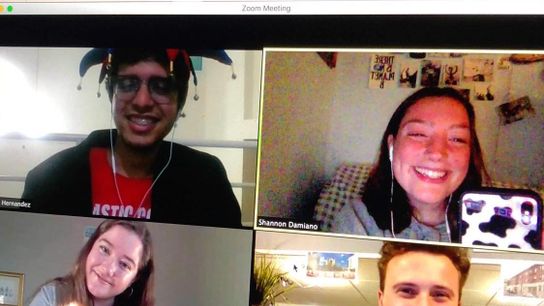
Ethan, Frank, Caroline, and Shannon work on The Sweaty Penguin in coronavirus quarantine.
In its podcast form, The Sweaty Penguin took off. We received over 50,000 downloads (2/3 under age 34), licensed episodes to PBS's climate initiative Peril and Promise, earned honors at the Webby and Signal Awards, won Boston University's New Venture Competition, became a Solutions Journalism Network Climate Beacon Newsroom, and welcomed the contributions of over 40 college students and recent graduates over four years. Between our Deep Dives, Bonus Episodes, and our later news-style spinoff series "Tip of the Iceberg," The Sweaty Penguin published over 220 episodes, well-received by audience members of all ages and political perspectives.
Into the classroom!
In Spring 2023, the University of Kansas unveiled a new course — "Geographic Adventures in Climate Change" — taught by Professor Shannon O'Lear. After learning many of her previous students never read the textbook, Shannon developed this course that replaced the textbook with The Sweaty Penguin, using a Course Transformation grant from KU's Center for Teaching Excellence. She turned the grant into scholarships for three undergrads who had recently taken an introductory geography course and done well. She asked these students to work as consultants to design the course, meeting biweekly for a whole semester in 2022 and collaborating with myself and The Sweaty Penguin team in how best to use our content.
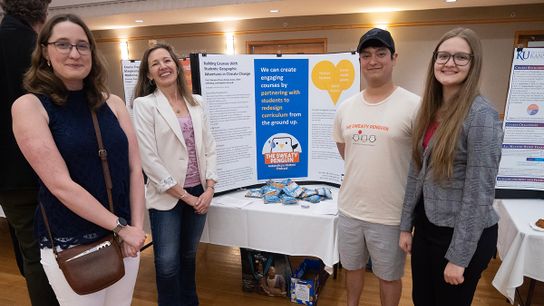
Prof. O'Lear and Students present course at KU Center for Teaching Excellence symposium, May 2023
They came up with a class that is beyond “flipped.” This course has been widely appealing in terms of the topic of climate change and current events. It is designed to be inviting in terms of an open classroom setting, no textbook, and the integration of a timely, age-appropriate podcast. This course aims to boost interest in the field of Geography by demonstrating how current events and familiar phenomena may be usefully understood and analyzed by applying systems-centered and spatial thinking across human and environmental processes.
The first iteration of the course, taught in Spring 2023, had an enrollment of 23 students, and was a rousing success. There was a consistent and enthusiastic core of about 14 people (a higher attendance rate than most courses) who showed up no matter what and generated all sorts of interesting ideas and conversations. I did a Zoom visit in April which received full attendance, and I was blown away by the appreciation for the podcast and depth of climate discussions in class.
In Spring 2024, KU taught the course a second time. I had the opportunity to visit in-person for a live event and classroom visit. Seeing students express how The Sweaty Penguin opened their eyes to the nuance and solutions in the climate space was a remarkable validation that our approach works.
The future
Unfortunately, The Sweaty Penguin lost its podcast funding in summer 2023, and I concluded the podcast and let my team go in January 2024. While The Sweaty Penguin is no longer a full time job (far from it), I completed a full redesign of the website in April 2024 with support from BoomPress, and have remained committed to keeping the website alive as a resource for anyone anxious about climate change to find nuanced, hopeful, nonpartisan news. This curation would not be possible without our collaboration with Covering Climate Now, and the generosity of several nonprofit newsrooms who share their reporting through Creative Commons licenses.
The stories I choose to republish reflect our mission to counter climate anxiety, bridge political divides, and show that progress is possible and happening now. Solutions journalism — reporting that explores responses to climate challenges and examines how well they work — makes up the largest share of what we republish. We believe these stories best illustrate our conviction that climate action can create economic, social, and environmental benefits without unnecessary trade-offs.
I also have a soft spot for well-crafted reporting on attribution science, a powerful and growing field that helps explain the links between climate change and specific extreme weather events. By grounding these connections in rigorous, peer-reviewed science, attribution studies give readers a clearer understanding of how climate change does and does not influence extreme weather. Beyond those topics, we share stories — including occasional opinion pieces — that demonstrate bipartisanship or offer insight into climate anxiety.
The Sweaty Penguin has never been a one stop shop for climate journalism. For example, while holding leaders accountable is essential in journalism, we do not republish stories that focus heavily on individual political candidates or ideologies. I am firmly committed to the mission of bringing everyone from all political perspectives into the conversation, and recognize that other newsrooms have other forms of journalism covered. We hope our curated catalogue helps point readers in the direction of other newsrooms doing exemplary work.
In the near future, I intend to build on The Sweaty Penguin's news curation efforts with a newsletter. I now work full-time as Training Program Coordinator at the University of Rhode Island's Metcalf Institute, which works to support journalists and scientists in advancing accurate and accessible conversations on climate and environmental science. While I have limited bandwidth for additional projects, I do hope to continue engaging The Sweaty Penguin community and upholding its mission as much as I can.
To support me in that effort, join our Patreon! The Sweaty Penguin's primary revenue source now is YOU — and by joining, you ensure The Sweaty Penguin can continue delivering climate news, engage our audience, and, well... keep the lights on. All patrons receive a special login for our website, which allows you to view extended podcast cuts and other exclusive content. We also offer merch, signed books from experts, and more to our patrons.
I was never the outdoorsy type growing up. I was climate-anxious too, but after getting a degree in Environmental Analysis & Policy from Boston University and speaking to nearly 150 experts through this podcast, I am now more hopeful than ever. Whether you're a doomer, denier, or somewhere in between, welcome to The Sweaty Penguin. I look forward to hearing your perspective and moving this climate solution train forward together!
A huge thank you to The Sweaty Penguin's many wonderful team members over the years: Olivia Amitay, Will Andronico, Megan Antone, Bobbie Armstrong, Alia Bonanno, Tim Choi, Sophie Colbert, Hallie Cordingley, Megan Crimmins, Haley Cronin, Shannon Damiano, Dare Fitzpatrick, Iliana Garner, Velina Georgi, Saige Gipson, Mikaela Gonzalez, Ali Harrison, Frank Hernandez, Emma Jones, Dain Kim, Caroline Koehl, Ziyang Li, Sofia Mansilla, Gabby Mussulman-Watson, Melina Nguyen, Korin Norton, Ana Lucia Perla, Isabel Plower, Maxwell Pociask, Mo Polyak, Emma Quarequio, Owen Reith, Sabrina Rollings, Naomi Rubin, Madeleine Salman, Sarika Sawant, Maddy Schmidt, Aana Shenai, Trevor Snow, Ainsley Jane Tambling, and Ysabel Wulfing.
And another huge thank you to our patrons: Lawrence Harris, Brownies Central, Laura Harris, Jack Brown, Lisa Breeland, Laura Crimmins, Mike Amitay, Shannon O’Lear, Brian Mirletz, Todd, Tim Choi, The Vllorla2, and Jane Michelbach.