
This article by The Revelator is published here as part of the global journalism collaboration Covering Climate Now.
Seventy-two-year-old Namgaukum, from India’s northeastern state of Nagaland, cherishes rare childhood memories of riding an Asian giant tortoise (Manouria emys phayrei) through the forests near his Old Jalukie village.
For the then five-year-old, the nearly two-foot-long carapace of the animals — the largest living tortoise in mainland Asia — often resembled a greyish-brown boulder in the forest about a foot above the mushy leaf litter and undergrowth.
“I would sit on it in the jungle, and after some time suddenly sense stirrings below,” he recalls. First a dark-brown head would cautiously pop out of the “boulder,” followed by a thick, muscular neck and sturdy, scaly legs pressing into the forest floor. “Then we would slowly amble forward, its beak nibbling grass and tender shoots,” he laughs, reminiscing his childhood thrill of riding the giant forest reptile.
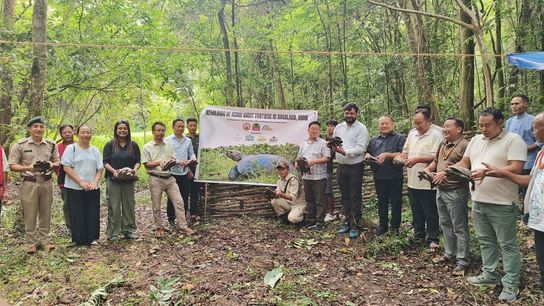
Newme Shamma, used with permission.
At the release event of the critically endangered Asian Giant Tortoises in the Old Jalukie Community Reserve last August.
The village elder remembers the tortoises were still abundant in the forests those days, and laments that they had almost disappeared by the time he was 13 or 14.
However, six decades later, a younger resident beams at the “homecoming” of this critically endangered species to the same Old Jalukie forests near his village — now a community reserve. “They are like our children now,” says 22-year-old Haileulungbe, proud to be acknowledged as a “Tortoise Guardian.” Other youths and members of the Zeliang tribe are equally overjoyed at the revival of the species in the wild.
This recovery follows a landmark initiative under the India Turtle Conservation Programme. Last August 10 captive-bred juvenile Asian giant tortoises (each 5–6 years old) were reintroduced into a community-owned and managed reserve rather than the usual state-run protected areas.
The program — implemented by the Nagaland Forest Department in collaboration with the Turtle Survival Alliance Foundation India at Old Jalukie Community Reserve in Peren district — aims to “rewild the growing number of captive-bred individuals and save them from extinction through community stewardship,” says its director, Shailendra Singh.
From Pets and Meat to Freedom
The effort began in 2018 with a captive-breeding facility under the ITCP at Nagaland Zoological Park. It was founded with 13 individuals of wild origin — seven females and six males — recovered from Tribal households, where they were kept as pets, and from local markets, sold for meat. Today the facility hosts the world’s largest assurance colony of Asian giant tortoises, with 114 individuals.
“The program reached its turning point when some villagers voluntarily donated tortoises they had kept as pets in their homes for captive breeding, and the community that once exploited them was sensitized to restore and nurture the species back in the wild from the brink,” says Singh.
Seven to eight months post-release, all the radio-tagged tortoises are reported to be healthy and surviving. Initially kept within a 10,000-square-foot bamboo enclosure in the Community Reserve for acclimatization, they were released into the wild on Feb. 20 this year.
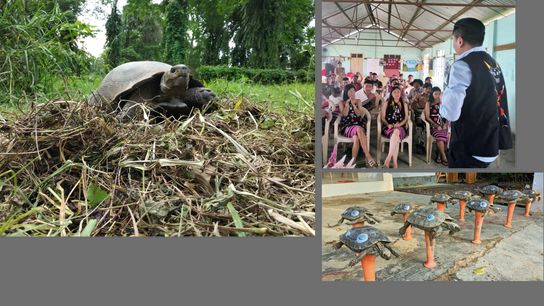
Shailendra Singh, Sushmita Kar, Shailendra Singh, used with permission.
Left to right: A female Asian Giant Tortoise guards her nest made of leaf litter and plant material. They are among the few tortoises in the world with the unique habit of building nests above the ground. A sensitization workshop with local communities conducted by program leaders and the heads of the forest department. Ten radio tagged juveniles of Asian Giant Tortoise prior to their release in the Conservation Reserve.
They now roam free in the wilderness of the Old Jalukie Reserve’s 370-hectare stretch of hilly semi-evergreen forests, with dense vegetation comprising native trees such as Indian chestnut, Nepalese alder, Karoi tree, and various oak species. The biodiverse landscape has been owned and managed by local tribes since the 1980s from 15 surrounding villages, with elders at the helm.
Vanishing Giants
The species faced a grim situation even two decades ago. Over the past 135 years, the tortoises have lost nearly 80% of their historic range across South and Southeast Asia due to habitat loss, hunting, and the pet trade.
Only about 250 mature individuals of the Asian giant tortoise may survive in the wild globally, according to Shailendra Singh, director of TSAFI. Of the two recognized subspecies, Manouria emys emys is extant in parts of Malaysia, Sumatra, and Borneo, while the larger, darker M. e. phayrei ranges across parts of Thailand, Myanmar, Bangladesh, and Northeast India.
Singh says that between 2012 and 2026, only 20 adult individuals have been reported from the northeastern states of Nagaland, Manipur, Assam, Meghalaya, and Mizoram, although inaccessible hilly terrains and social conditions may have limited surveys and detectability. He estimates that around 100–150 adults may survive in the region.
Building Support
Villages in the region traditionally hunted the tortoises for generations, so securing the support of local communities was crucial if the reintroduction program was to succeed, points out Sushmita Kar, turtle biologist and Project Coordinator, ITCP for Northeast India.
“The Forest Department helped bring local communities on board, keep them motivated, and take them along on this conservation journey,” says Chisayi, divisional forest officer, Peren (from the Indian Forest Service). He explains that the department works with communities at the grassroots through capacity building and livelihood opportunities, envisioning a future where Old Jalukie can be projected as a “tortoise village” in the state.
“As major stakeholders, local communities become more responsible and accountable for conserving the species and the habitat as a whole,” he adds.
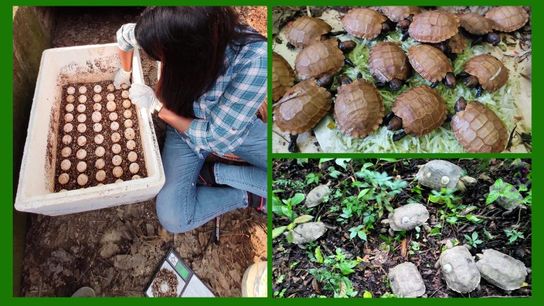
Lalit Budhani, Sushmita Kar, Shailendra Singh, used with permission.
Left to right: Successful artificial incubation of the eggs of the Asian Giant Tortoise at the captive breeding centre in Nagaland Zoological Park. Tiny hatchlings of Asian Giant tortoise emerge after artificial incubation. Asian Giant Tortoises on the damp forest floor after their release at the Old Jalukie Community Reserve.
Releasing the tortoises in a community reserve rather than a conventional protected area was a conscientious decision, admits Kar. The approach also followed lessons learned from the first phase of giant tortoise reintroduction at Intanki National Park in December 2022. Of the 10 captive-bred juveniles released then, only one was later found at the forest periphery; two were trampled by elephants, while the fate of the rest remains unknown.
Unlike national parks, community reserves do not restrict access for local villagers. To help make villages aware of the importance of the species, youths are given hands-on field training for regular monitoring of the tortoises. “For a species where every individual counts, these youths, with their almost ‘one-to-one involvement’ with each, develop familiarity and a sense of belonging, ensuring their long-term survival,” she says.
Besides, during the monsoon, when forests become difficult to access, these grassroots conservationists can still move through the terrain and remain vigilant, guided by their lived experience and traditional knowledge.
Meanwhile, unlike most Indian states where forests are largely under government control, nearly 88% of Nagaland’s forests are governed and managed by local communities, clans, and individuals through village councils and traditional institutions. According to official reports, the state has 407 community-conserved areas safeguarded by traditional laws, as well as 148 formally notified community reserves — the highest in the country and accounting for more than 50% of all such reserves nationally.
Such programs as the ITCP offer good examples of how community reserves can be effectively used for the revival of such critically endangered species, according to Kenlumtatei, Range Officer, Jalukie Range. “It is also bringing about an attitudinal change among community youths, who are gradually moving away from traditional hunting to protect forests and wildlife,” he adds.
Tortoise Guardians
For youths like Haileulungbe and Iteichube from the Old Jalukie Conservation Reserve, it means their enhanced role and commitment as its custodians.
Donning olive-green T-shirts printed with “Tortoise Guardian,” Haileulungbe sets off for the forest at 8 a.m., when the reptiles are most active. He carries a radio receiver, while the project field researcher Victor carries the antenna connected to it. The duo scans for signals from their radio-tagged “giant children” to pinpoint their locations. “Two of the tortoises have already moved about 300–500 meters from the enclosure site,” he says excitedly as they walk me through the forest.
They have been trained to maintain daily records of each individual tortoise’s GPS location, along with observations of their movements and behavior.
Apart from following signals on the radio receiver, they also look for nibble marks on leaves, their favorite bamboo shoots, or mushrooms on the forest floor, or shallow depressions in wet grasslands and puddles, explains 33-year-old Iteichube, another tortoise guardian. “All such signs enable us to identify their basking, foraging, and resting sites,” he adds.
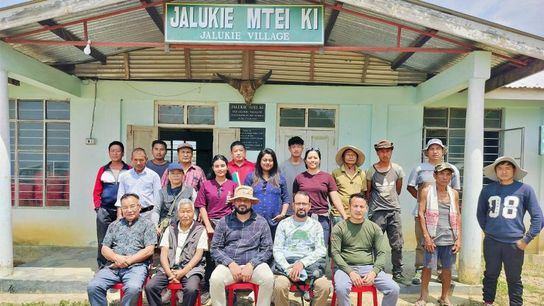
Haileulungbe, used with permission.
A community awareness event with local villagers, forest department officials and scientists.
With adults weighing about 36–37 kilograms (79–82 pounds), they are often described as the “small elephants of the forest” because of their thick, scaly legs that push through dense vegetation, a process that also aids seed dispersal and forest regeneration.
They are among the few tortoises in the world with a unique nesting habit: building nests 2-3 feet above the ground with leaf litter and plant material to lay about 25–70 eggs per clutch. Most tortoises, by contrast, nest by digging holes in the ground.
Seeing their behavior further inspires the guardians. “We started by simply tracking them, but today we realize how important they are in keeping our forest vibrant and alive with their unique ways,” says Iteichube.
The Next Generation
Inspired by the rewilding success of Asian giant tortoises in Nagaland, similar efforts are now underway in neighboring Manipur. Early results are already emerging: A captive-breeding facility set up at the Manipur Zoological Garden successfully produced 28 hatchlings through artificial incubation in August 2025.
As the hatchlings grow, scientists are also carrying out site assessments and searching for Asian giant tortoises in the wild to identify potential release sites of captive-bred individuals. “We aim to repopulate Manipur’s forests with giant tortoises, as in Nagaland, and eventually across its historic range in the Northeast India, through community participatory approach,” says Kar.
Shailendra Singh, used with permission.
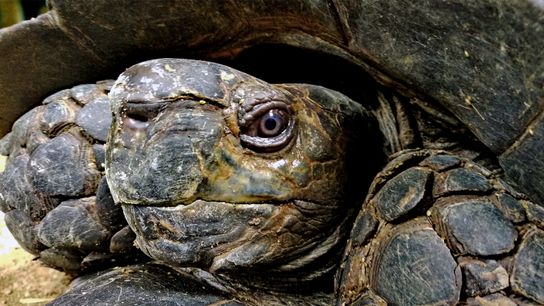
An adult male Asian Giant Tortoise pops its greyish-brown head and forelimbs out of its carapace.
The village elder Namgaukum could not be happier with the return of the tortoises to their native forests.
“Earlier we would hang its large, beautiful shells outside our homes to ward off evil and as a symbol of pride, but today we consider it a good omen and blessing for our community to see it flourish in the wild,” he says.