


This article originally appeared in Mongabay.
PAU BRASIL, Brazil — Indigenous leader Fábio Titiah recalls the night he walked the trail to the village of Água Vermelha, in the Caramuru-Paraguassu Indigenous Territory. At around 10 p.m., a shadow burst from the undergrowth and sprang across the road. He says he saw, startled, its glistening, pitch-black pelt and recognized it as one of the rarest animals of Brazil’s Atlantic Forest: a black jaguar (Panthera onca).
For Titiah, one of the 21 caciques (chiefs) of the Caramuru-Paraguassu territory in Brazil’s northeastern state of Bahia, the fleeting sighting of the big cat was a spiritual encounter and a sign of changes afoot in Indigenous lands.
“There was a time when we started the reclamation process, when we [re]occupied our territories, and found a large part of our land transformed into cattle pasture,” Titiah tells Mongabay at his house in the municipality of Pau Brasil, adjacent to the Caramuru-Paraguassu territory, where he’s a city councilor. “Then our people left a good part of these areas to regenerate. Some animals that hadn’t been seen here before started appearing. The jaguar started to return.”
The transformation of the Caramuru-Paraguassu territory has been enabled in part by Ywy Ipuranguete (“beautiful lands” in the Tupi-Guarani language), a nationwide project to strengthen and support Indigenous stewardship across 15 Indigenous territories. Building on the recognition of Indigenous lands as vital for wildlife and ecosystems, Brazil’s Ministry of Indigenous Peoples launched the initiative to safeguard about 6 million hectares (15 million acres) of some of Brazil’s most threatened biomes, including territories in the Amazon, Pantanal, Atlantic Forest, Caatinga and Cerrado.
Karla Mendes/Mongabay
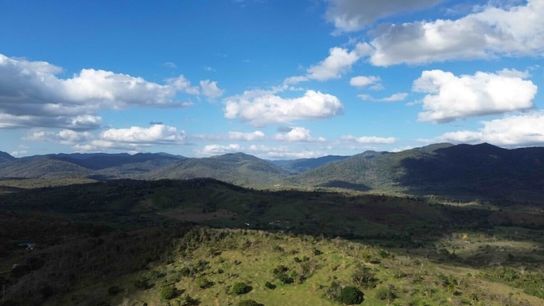
Aerial view of the Caramuru-Paraguassu Indigenous Territory in Brazil’s northeastern Bahia state. Although the territory was officially recognized in 1926, it was illegally occupied by cattle ranchers for decades, which changed its climate, soil and forest characteristics.
The initiative brings together government officials, Indigenous leaders and funding organizations. Inaugurated on March 18, 2025, it’s backed by $9 million in funding from the Global Biodiversity Framework Fund.
According to big cat experts Ronaldo Morato and Rafael Hoogesteijn, the process may also benefit jaguar conservation in the territories it touches. Some of the key remaining hotspots of jaguar populations are on Indigenous lands.
“The jaguar is a sacred animal,” Titiah says. “It is a very special animal to us, considered one of the spirits of the animal world, a very powerful spirit that strengthens, gives agility and skill.”
Strongholds of survival
The jaguar once ranged across a vast swath of the Americas, from what is today the southwestern United States to northern Argentina. Today, the cat is considered extinct or possibly extinct across roughly 47% of its historic range in South America. It’s considered near threatened on the IUCN Red List, due to pressure from habitat loss, depletion of its prey species, and poaching.
Brazil is home to approximately half of the world’s jaguars, with strongholds in the Amazon Rainforest and Pantanal wetlands. But the cat’s populations in the Atlantic Forest and the Caatinga dry forest, both of which are part of the Ywy Ipuranguete initiative, are down to just a few hundred individuals persist and considered critically endangered.
Ideally, jaguars require habitats with minimal environmental disturbance, making protected areas essential for their long-term survival, according to Hoogesteijn, a member of the Cat Specialist Group at the IUCN, the global wildlife conservation authority.
“Jaguars are very adaptable mammals and can adjust to many different environmental conditions, but those conditions dictate the density of wild prey and the size of jaguar home ranges,” he says. “The problem is that in all Latin America, habitat loss is accelerating, so it’s very important to maintain protected areas intact without deforestation and the corridors between them to maintain the genetic connectivity of populations.”
In recent years, there’s also been growing recognition of the role of Indigenous lands as jaguar strongholds. In the Amazon, half of the jaguar population and the main areas for species conservation are on Indigenous lands, says Morato, also with the IUCN Cat Specialist Group and the Brazil director for wildcat conservation NGO Panthera.
“Jaguar population densities are higher in Indigenous lands, which generally experience lower deforestation rates and have higher ecological connectivity than non-Indigenous protected areas,” Morato tells Mongabay.
According to a 2023 study, eight of the top 10 highest-priority protected areas in the Brazilian Amazon for jaguar conservation are Indigenous territories: Arariboia, Apyterewa, Cachoeira Seca, Kayapó, Marãiwatsédé, Uru-Eu-Wau-Wau, Xingu and Yanomami. The other two are the Terra do Meio Ecological Station and Mapinguari National Park.
Morato and Hoogesteijn say they hope that Ywy Ipuranguete — and the funding and resources that back it — will serve as an additional layer that supports existing Indigenous efforts to protect the species. The Kayapó territory, a hotspot for jaguar conservation, is also part of the Ywy Ipuranguete.
The initiative will focus on Indigenous territories across the states of Pará, Mato Grosso do Sul, Ceará, Pernambuco and Bahia. Among the Indigenous nations involved are the Munduruku, Pataxó, Kayapó, Guarani-Kaiowá, Pankararu, Tremembé, Terena and Kadiwéu.
So far, there are little to no links between the project and jaguar conservation programs. The initiative is still in its early stages, and sources say they hope conservation efforts, even if not explicitly aimed at jaguars, can have a ripple effect on protecting the species.
As it gets off the ground, Ywy Ipuranguete seeks to boost Indigenous self-governance, support communities in monitoring their territories, restore degraded environments, ensure sustainable income generation, and improve food security and sovereignty, the Ministry of Indigenous Peoples told Mongabay by email. By giving local leaders the tools to manage their lands, the initiative allows Indigenous communities to organize activities, protect forests, and maintain traditional practices while helping wildlife — including jaguars — thrive.
“The focus on biodiversity monitoring and landscape governance is really positive,” Morato says. “It will be interesting to see how protection of these areas is secured through Indigenous governance. I think it will be important for jaguar conservation and biodiversity conservation in general.”
In Indigenous territories, local beliefs, taboos and traditions surrounding the big cat (even when it’s hunted) often directly support its conservation, according to Fábio Dario, an ethnobiologist and independent researcher at Ploaia Agronomy, Ecology and Environment, a research institute.
“The jaguar is both an ecological and cultural keystone species,” Dario says. “Encounters between people and jaguars can be seen as rites of passage, or they may bring prestige, as well as important moral, religious and spiritual lessons. The symbolism of the jaguar extends well beyond the ecological.”
In Bahia, the Ywy Ipuranguete initiative has already been embraced by the Pataxó Hãhãhãe community, who live on reclaimed land officially recognized as Indigenous territory since 1926 but illegally occupied by cattle ranchers for decades.
“We took land that had already been devastated by extensive cattle ranching,” Titiah says. “When our people recovered it, the land no longer had the same climate, soil or forest characteristics as before.”
With land security in place, the challenge has shifted from recovery to long-term stewardship. Through Ywy Ipuranguete, the Pataxó are now working to organize how their territory is used and protected, balancing production, conservation and traditional practices.
“What we need most today is to actually organize and plan how we are going to use this territory. We need to define areas for preservation, help to reforest, and strengthen the environmental issue, because nature, by itself, if left untouched, can recover. And some animals that hadn’t been seen here before started appearing,” Titiah says, adding, “The spotted jaguar, which people hadn’t heard of, started appearing. So, this is a demonstration that where the community arrives and starts to occupy, these animals start to reappear as well.”