
This article originally appeared in Mongabay.
In the rolling hills of Iñapari, a remote town in the Peruvian Amazon on the tri-border with Bolivia and Brazil, cattle ranchers are ditching grass monocultures, which have been shown to harm biodiversity, in favor of forested pastures. For Antonio Cardozo, a local rancher who has planted hundreds of native trees, the switch has improved his cattle’s diet and health, while also providing him with additional sources of food and income.
“Learning has a cost, but in a few years you start to see a difference,” says Cardozo, who has been combining trees with rotational grazing, a practice that keeps the soil intact and allows grass to regrow. In less than a year, this practice allowed him to more than double the number of cows he grazes per hectare
Livestock farming is responsible for roughly 80% of the deforestation in the Amazon Basin and 14.5% of greenhouse gas emissions globally. Yet agricultural solutions receive just 7% of global climate funding and were absent from the recent COP30 climate summit agreement. According to some researchers, planting trees in pastures, an agroforestry technique known as silvopasture, represents one of the most effective yet neglected opportunities to reduce global greenhouse gas emissions. Under ideal conditions, silvopasture sequesters carbon in trees and soils while providing better forage and shade to heat-stressed cows, leading to healthier animals that emit less methane and occupy less land. It can also help small farmers adapt to climate-related disasters — responsible for $2.9 trillion in losses over the last 33 years, according to the U.N.’s Food and Agriculture Organization — by improving food security and resilience to floods, drought and heat stress.
Despite its promise, however, silvopasture adoption remains low across Latin America. But that’s beginning to change as more private and public support rolls out to farmers like Cardozo. According to a review paper published in November, the main factors stopping ranchers from adopting the method are a lack of financial incentives and technical know-how. Well-designed silvopastoral systems can increase profits, but planting trees is expensive and requires large investments in time, education and labor.
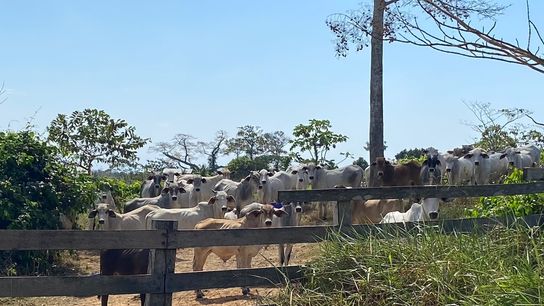
Charlie Espinosa
A herd of cows in a forested section of Antonio Cardozo’s farm.
“Farmers may seem like the main decisionmakers,” says study lead author Tatiana Chamorro-Vargas, a doctoral candidate at the Institute for Resources, Environment and Sustainability at the University of British Colombia in Canada, “but actually macro-scale factors like policies and market conditions are what drive adoption.”
In Latin America, where livestock production is the leading source of agricultural greenhouse gas emissions, a growing list of countries have adopted silvopasture as national policy. The latest is Peru, which has incorporated the technique into both its National Livestock Development Plan and its national climate plan, or nationally determined contribution (NDC), becoming the 10th Latin American country to do so.
“We did a cost-benefit analysis in terms of emissions reductions and silvopasture emerged as a clear priority,” says Carlos Gómez Bravo, a professor of animal science at the National Agrarian University in Lima, who worked with Peru’s Ministry of Environment on the country’s NDC.
Under the plan, the ministry pledged to convert 119,000 hectares (about 294,000 acres) of degraded land in the Amazon into silvopasture by 2030 — though Gómez says the ministry has made little progress to date and lacks a reporting mechanism to track progress.
Planting trees in pastures alone doesn’t guarantee environmental or economic benefits. To be effective, silvopasture must check off a set of conditions, and some experts worry that investing in more sustainable ranching could have knock-on effects, like diverting investment from plant-based food production or spurring further forest clearing if farmers use the extra income to expand their operations. Still, early evidence suggests that the tropics of Latin America, including the Amazon, may be especially well-suited to silvopasture, provided it’s done right.
An Amazon-specific design
The cattle ranches that cover more than 75 million hectares (185 million acres) of the Amazon biome, nearly 10% of its total area, are not only biodiversity vacuums, they’re also inefficient. In the Peruvian Amazon, where most ranches are small-scale, a hectare of land supports less than half a cow and yields a net cash flow of only about $50 on average.
“We are in a place [tropical forests] with the highest terrestrial primary productivity in the world and we’re converting it into one of the lowest productivity cattle farms,” says Lucy Dablin, a lecturer in environment and sustainability at the Open University in the U.K. “So the challenge is how can we reconcile these two things?”
For her doctoral thesis at University College London, Dablin spent nearly a decade trying to answer that question, creating an Amazon-specific silvopasture design that evaluated native trees based on environmental, economic and local conditions. “I spoke to a lot of farmers about cows and trees for a long time. I found that trees and pastures can increase forage for cattle and carbon sequestration,” says Dablin, whose research was the first to empirically demonstrate that silvopasture in the Amazon could increase forage production compared to grass pastures.
One highlight of Lucy’s research is a fast-growing legume called Inga edulis, known in English as ice-cream bean for the vanilla-like flavor of its fleshy fruit. Cows love its protein-rich leaves, which regrow quickly and provide shade, while the nitrogen-fixing roots improve the fertility of degraded soils. Finding the right forage helps cows pack on the pounds — meaning they can be sent to slaughter sooner and have less impact — and in some cases even produce more milk and burp less methane during their lives.
Drawing on research by Dablin and the FAO, WWF has been promoting silvopasture and rotational grazing in Peru’s Iñapari and the surrounding Madre de Dios region since 2019. To date, it has trained roughly 500 producers and set up about 40 hectares (100 acres) of silvopasture pilots, prioritizing degraded areas that can serve as wildlife corridors, including for jaguars. According to Karina Salas, Southern Amazon landscape manager at WWF Peru, science matters, but rancher input matters more: “Landowners have to feel like it’s their plot, and that they’re the ones who decided what species were used and how.”
“Each property is different,” says Cardozo, who was trained by WWF and now hosts workshops for other ranchers. “You have to listen to what the land tells you and use the species that grow here — castaña [Bertholletia excelsa], shihuahuaco [Dipteryx micrantha], capirona [Calycophyllum spruceanum],” he says, naming the native trees that line the edge of his pasture.
‘Economics will always be pivotal’
Cardozo is a third-generation rancher who supplements his income with fish farming and small-scale agriculture. Traditional farmers like him have been open to silvopasture, but many cattle owners aren’t interested in long-term commitments — they treat cows as essentially a savings account that can be quickly liquidated when the time is right. “You have to be careful because you can lose the trees, the pasture, the investment, and you can lose motivation,” Cardozo says.
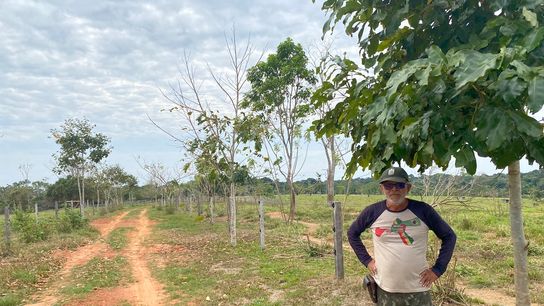
Charlie Espinosa
Antonio Cardozo stands near a fence lined with recently planted native trees.
Even for ranchers like Cardozo, making silvopasture economically viable without support is hard. While the boost in efficiency from silvopasture and rotational grazing can triple productivity within a few years, it can take decades to recoup the upfront costs, and banks rarely give out loans to farmers except at prohibitively high interest rates. According to the study by Chamorro-Vargas at UBC, providing farmers with financial incentives — such as payments for ecosystem services or tax breaks — is key to expanding the technique.
“The big bottleneck is finance,” says Nelson Gutierrez, who worked with WWF and is now project manager at Imperative Inc., a carbon project developer. “Silvopasture is expensive. Without the private sector, I don’t think this can happen at scale.”
Even after landowners set up silvopasture, there’s no guarantee they will keep it over the long term. “Economics will always be pivotal,” says Gómez, the animal science professor. “If a farmer sees that palm oil can make more money, he might cut down the trees and plant palms. To be sustainable, silvopasture has to be profitable.”
A global climate solution?
In late September, climate solutions think tank Project Drawdown published an updated in-depth analysis of silvopasture, ranking it a “highly recommended” solution that could capture 0.4-0.98 billion metric tons of carbon per year if adopted at scale — equivalent to roughly 40% of the emissions it estimates would be saved by replacing all fossil fuel–powered cars with electric ones.
“It’s effective because trees are effective,” says Eric Toensmeier, senior research fellow with Project Drawdown and lead author of the analysis. “But there’s a limited amount of space where we can add trees because we have to eat, so silvopasture is a way to add trees to existing food systems while providing a lot of benefits for that food production.”
Whereas silvopasture can be beneficial in certain ecosystems, it can be harmful in others, such as native grasslands, where nonnative tree plantations can crowd out biodiversity. And while it can significantly boost efficiency in the tropics, that is not always the case in temperate, industrialized contexts like the U.S., where cows are fattened on feedlots, which tend to be efficient but dire for animal welfare.
“If you find … where silvopasture works and you can improve efficiency, great, but we need to be very cautious about exporting it to other places,” says Jess Zionts, a Ph.D. researcher at the University of Oxford in the U.K. who focuses on the beef industry. Zionts says silvopasture could ease pressure on forests, but she’s more hesitant about its role in carbon sequestration, citing concerns about the carbon opportunity costs of animal agriculture and permanence, or the risk that carbon in soil and trees could be reemitted into the atmosphere through wildfires or changes in land use.
The future: Pasture versus crops
While there’s some debate on how to measure carbon benefits, there’s one point where nearly all climate scientists agree: to meet the Paris Agreement, the world, especially rich countries, needs to drastically cut back on dairy and meat.
“Even with the most intensive silvopasture system, if you grow beans, you get 10 times more protein per hectare,” Toensmeier says. According to Project Drawdown, cutting out pastured animals like cows, sheep and goats from diets is one of their most promising climate solutions, second only to deploying on- and offshore wind energy.
But even as plant-based diets gain popularity — an outcome the beef industry is campaigning aggressively to prevent — global beef consumption is still on track to rise by 80% by 2050. Meat production — which takes up as much land as the Americas from Alaska to the tip of South America — is not going away any time soon. But how that land should be managed and how much can be “freed up” for nature is a subject of scientific debate.
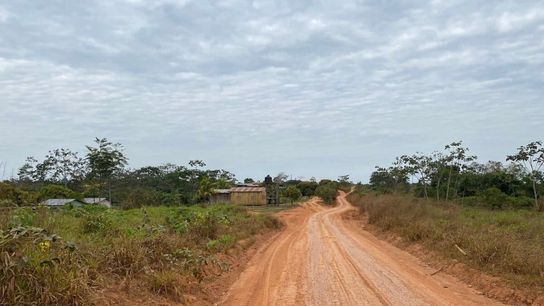
Charlie Espinosa
A dirt road leading to Antonio Cardozo’s property outside the town of Iñapari.
For her part, Dablin at the Open University says working with ranchers is necessary to protect an imperiled Amazon Rainforest. “You can’t just set up protected areas indefinitely,” she says. “Like it or not, the ones who have the most control over deforested land in the Amazon are cattle farmers. If we want that land managed sustainably, we have to support them.”
But Matthew Hayek, a professor of environmental studies at New York University in the U.S., says he worries that investing in solutions like silvopasture could be just another leg up for meat. “Over and over, we tell stories where helping animal agriculture expand is being pragmatic and helping plant-based, bio-economies get started is being idealistic.”
For Hayek, the key concern is whether silvopasture increases demand for beef, citing an economic paradox that says that greater efficiency can lead to more consumption. “If it does, then more producers get into the game, and on and on the economic story goes.”
Chamorro-Vargas, who works on silvopasture projects in her native Colombia, acknowledges the need to decrease meat consumption, but thinks abandoning producers is unrealistic. “It’s a social problem to tell ranchers, ‘You can’t do this.’ What are they supposed to do?” she asks, emphasizing ranching’s importance as a livelihood in Colombia. “We’re not saying cut down the Amazon to set up silvopasture. We’re saying this is one of the several solutions we need to create a more sustainable system.”